Protecting Solar Investments from the Ground Up with GEPS®

The solar energy revolution is reshaping land across the globe. Hundreds of thousands of acres have been converted to utility-scale solar arrays, each one generating clean electricity while standing on something that rarely gets discussed: the soil itself.
The panels in an array decrease surface area for the ground to absorb stormwater, and the same heavy equipment used to build these facilities leave behind compacted soils. Uneven and/or poor moisture distribution can be expensive for a solar installation, with drainage, maintenance, and repair costs creating a significant concern for solar developers, operators, and insurers as to long-term expense and longevity.
A passive, maintenance-free technology from Exlterra called the Groundwater Energy Passive System (GEPS®), addresses both of solar's major soil-related headaches: stormwater runoff driven by construction compaction and decreased permeable surface area, and long-term structural damage caused by uneven moisture distribution around panel footings.
The Compaction Problem

When a solar developer breaks ground, the land is fundamentally transformed. Heavy grading equipment levels terrain, pile drivers hammer steel posts into the earth dozens or hundreds of times per acre, and service vehicles travel repeatedly over the same paths during construction and throughout the operational life of the site. The result, confirmed by U.S. Department of Energy-funded research, is soil compaction — one of the single greatest stormwater management challenges facing the solar industry today.
A DOE-funded study known as PV-SMaRT, conducted by the Great Plains Institute in partnership with NREL and the University of Minnesota, found that compacted soils between solar arrays can roughly double the volume of stormwater runoff compared to undisturbed land. Unlike conventional development, where impervious surfaces are acknowledged and stormwater infrastructure is sized accordingly, solar facilities often occupy a regulatory gray area where they're treated as pervious when, in practice, their compacted surfaces can behave like parking lots during a rainstorm.
Solar panels also concentrate rainfall runoff at the lower panel edge, known as the drip line. Research at Pennsylvania solar farms found soil moisture directly beneath drip lines ran 19% higher than adjacent land over a full year of monitoring, while soil beneath the panels themselves ran 25% lower. These persistent wet zones erode the ground below them, overwhelm perimeter BMPs with sediment-laden runoff, and create compliance headaches for stormwater operators.
The Infiltration Problem

Each solar panel surface is a hard, smooth, non-absorbing plane. Rainfall that would otherwise be distributed across the ground at natural intensities is instead intercepted, accelerated across the panel face, and shed in concentrated sheets along the drip line. Panel coverage behaves much like a metal roof — high runoff coefficients, short time of concentration, and peak flows that arrive faster and with more energy than pre-development conditions would produce.
When the contributing panel area is scaled across hundreds of acres, this effect is substantial. A large utility-scale array may shade and redirect rainfall from a significant fraction of the site's total footprint. Regulatory frameworks that calculate impervious cover based solely on hardscape may dramatically undercount the effective runoff-generating area of a solar installation. Permitting assumptions built around a "mostly pervious" site can leave the project's stormwater calculations materially wrong before construction even begins, requiring costly and time-sensitive stormwater management solutions.
The fill and grading practices common to solar site preparation compound this further. Sites are typically cut and filled to achieve consistent panel orientation and minimize inter-row shading, often importing or redistributing significant volumes of material. Engineered fill, particularly when placed over existing topsoil without amendment, tends to be denser than the native soil it covers or displaces. Infiltration rates in fill zones may be only a fraction of what pre-grading conditions supported. When this reduced-permeability fill underlies inter-row areas that are also receiving concentrated drip-line flow, the runoff calculations worsen considerably. The site generates more water in more concentrated patterns, across soils that are less capable of absorbing it, than developers are ready for.
GEPS® directly addresses this compounding effect. By improving soil structure/behavior in compacted and disturbed zones — including fill areas — the system works to restore infiltration capacity passively over the operational life of the site. The inter-row areas where most of the problems occur are precisely the zones where a well-designed GEPS® installation can reintroduce infiltration that fill placement and construction traffic have removed.
The Structural Problem

The moisture gradient created by solar arrays is also a slow-moving structural threat. Differential settlement, where one part of a foundation sinks faster or deeper than adjacent sections, is well understood in geotechnical engineering. Its causes include variable soil composition, poorly compacted fill, and fluctuating soil moisture levels. Soils that cycle repeatedly between wet and dry states expand and contract; over years, this movement beneath neighboring pile footings is a reliable recipe for foundation problems.
For solar trackers with continuous torque tubes connecting multiple panel rows mechanically, even a few inches of relative movement between adjacent pile footings can bend and jam the tracker mechanism, crack welds, and require expensive repairs or early component replacement. A support that technically remains standing can still cause major operational problems if it shifts enough to misalign rows, stress cables, or put the array out of spec.
This risk compounds over the 25 to 30-year operational life of a typical solar installation. The soil beneath panels stays drier because it is sheltered from rain. The soil beneath drip lines stays wetter because it receives concentrated runoff. These chronic moisture gradients drive uneven shrink-swell behavior in clay soils, causing adjacent pile footings to settle at different rates over time. The problem rarely appears in initial project pro formas and frequently doesn't manifest until years after the original EPC contractor's warranty has expired.
The Infrastructure Problem

When a solar facility generates more runoff than the landscape can absorb, the excess water has to go somewhere. And getting it there safely and in regulatory compliance is not cheap.
Solar projects on sites with meaningful runoff impacts routinely require engineered drainage infrastructure: graded swales and ditches to convey surface flows away from inter-row areas, inlet structures to collect and route concentrated discharge, and detention or retention ponds to attenuate peak flows before release to receiving waters.
In many jurisdictions, stormwater management requirements are triggered based on calculated post-development runoff volumes, and a solar facility that honest hydrologic modeling treats as substantially impervious may face the same infrastructure obligations as a commercial shopping center of comparable size. Detention pond sizing, outlet control structures, emergency spillways, and the embankments that contain them represent meaningful capital cost — and, unlike the panels, they produce no revenue.
The ongoing maintenance burden of this infrastructure is also significant and poorly appreciated at the pro forma stage. Detention ponds accumulate sediment, particularly when upgradient drip-line erosion is active; forebays fill and require periodic excavation. Swales and ditches that carry concentrated, fast-moving flow erode their own banks and need regular inspection and regrading. Outlet structures clog, riser pipes corrode, and embankments require mowing and periodic inspection to meet dam safety requirements where they apply. These are recurring operational costs, not one-time construction items.
When GEPS® restores soil infiltration capacity in inter-row areas and moderates the concentrated discharge from drip-line zones, it reduces the hydrologic loading that the downstream drainage infrastructure must handle. A site that infiltrates more and discharges less through GEPS® may require smaller ponds, shorter swale runs, simpler outlet designs, or no additional stormwater designs altogether. The savings on infrastructure capital and the avoided maintenance cost over a 30-year project life represent real financial value that sits alongside GEPS®'s stormwater compliance and structural benefits.
GEPS® is the Solution
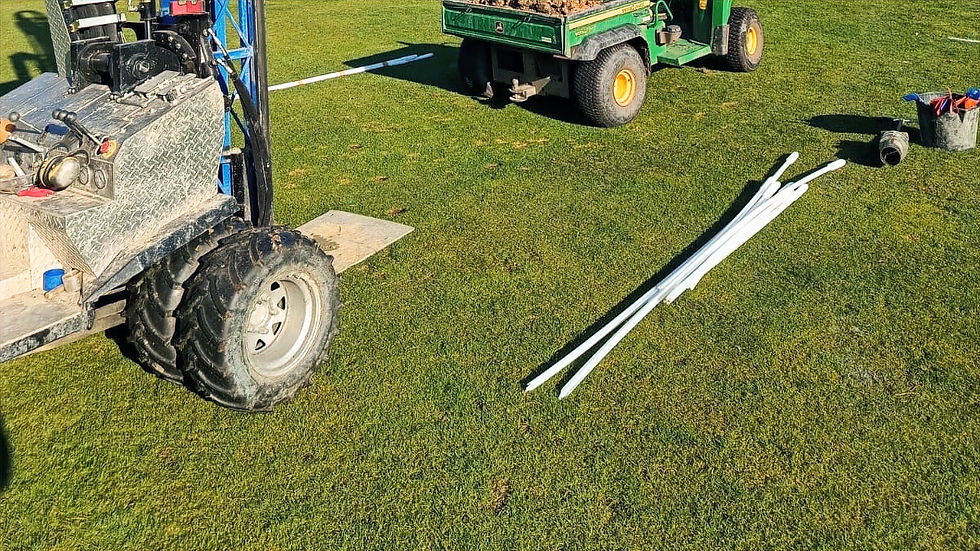
GEPS® is a passive soil moisture redistribution system. Each unit is a slender, 1¼-inch diameter polyethylene shaft available in lengths from 5 to 40 feet, installed using a lightweight drilling rig (the Exlterra HAZL) with a small-diameter auger. GEPS® operates by passively creating pressure conditions that allow moisture to migrate volumetrically in 3 dimensions through the surrounding soil matrix — even in low-permeability clay layers where vertical infiltration is typically limited.
During an acclimation period following installation, the soil reorganizes around each GEPS® unit, developing improved moisture balance and a healthier pore structure. GEPS® works with the natural hydrological cycle: when wet zones form, moisture migrates toward drier zones; when dry zones develop, moisture redistributes from wetter areas nearby. The system has no moving parts, requires no electricity, and demands no maintenance.
For solar fields specifically, this means two things:
Stormwater that previously ran off compacted soil begins infiltrating again as the pore structure recovers, reducing surface ponding and the concentrated flows that erode drip line soils.
The uneven moisture gradient between drip lines and under-panel zones gradually flattens as moisture redistributes laterally across the soil volume. Pile footings across the array end up in a more uniform moisture environment, reducing the differential shrink-swell behavior that drives damage during settlement.
The Case for Acting Early with GEPS®

Post-construction remediation of stormwater and erosion problems at solar sites is consistently more expensive than prevention. Scarifying detention pond bottoms, installing emergency erosion controls, and negotiating with regulatory agencies over compliance violations all cost real money and operational attention. Research cited in Chesapeake Bay watershed stormwater studies found that landscapes compacted by solar construction can remain so for a decade or more after panels are removed and the land is replanted.
Differential settlement repairs are similarly disruptive. Retrofitting or replacing continuous torque tube trackers after foundation movement requires taking rows offline, mobilizing specialized crews, and potentially revising engineering documentation. The structural consequences of soil moisture mismanagement often don't surface until year five, ten, or fifteen of a project.
GEPS® addresses both problems through a single installation. The technology leaves no above-ground infrastructure to interfere with maintenance vehicles. A 40-foot unit influences a soil volume approximately 52 feet in diameter, meaning a well-designed array of units can cover the inter-row spacing of a large solar facility with overlapping zones of influence. The system begins acclimating immediately after installation and continues working for the full operational life of the project.
As solar development moves toward more challenging sites — heavier clay soils, complex hydrology, former agricultural land with compaction history — the need for tools that address soil health proactively will only grow. GEPS® provides solar operators a way to meet that challenge without adding operational complexity or ongoing maintenance burden.
Panels are important, but the ground the panels are installed on can make or break a long-term investment into solar.
Interested? Learn more or find a licensed installer near you today!


Comments